
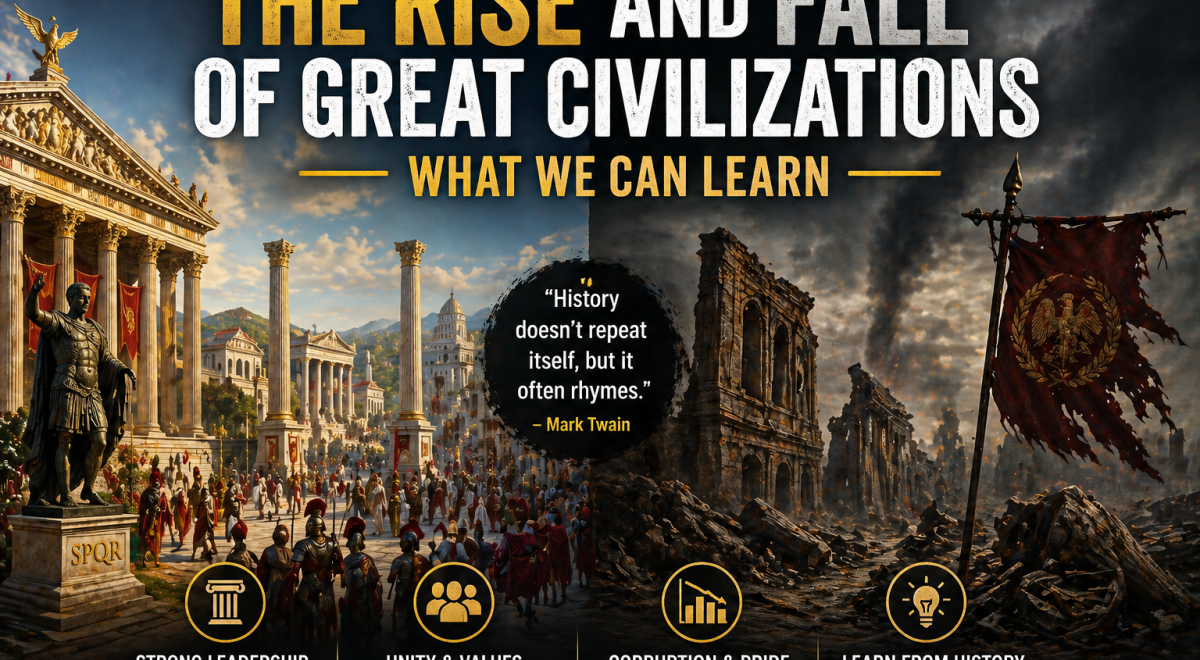
Throughout history, many powerful societies have grown, dominated, and eventually declined. Understanding the rise and fall of great civilizations helps us learn valuable lessons about success, leadership, and long-term sustainability.
Why Study the Rise and Fall of Civilizations?
Studying the rise and fall of great civilizations is not just about history—it is about understanding patterns. These patterns show us how success is built and how failure happens. By learning from the past, we can make better decisions in our own lives and societies.
A Real Lesson from History: The Rise and Decline of the Roman Empire
One of the best examples of the rise and fall of great civilizations is the story of the Roman Empire.
At its peak, the Roman Empire was one of the most powerful civilizations in the world. It had strong armies, advanced engineering, organized government systems, and a growing economy. Roads, laws, and infrastructure made Rome highly successful and influential.
However, over time, problems began to grow.
Leadership became weaker, and corruption increased. The economy started to decline, and heavy taxes affected the people. Internal conflicts and divisions weakened unity. At the same time, external threats from invading groups became stronger.
Instead of adapting and fixing these problems early, many leaders ignored the warning signs. Slowly, the empire became weaker until it eventually collapsed.
What This Story Teaches Us
This real example clearly shows that success is not permanent. The rise and fall of great civilizations is often the result of decisions, leadership, and the ability—or failure—to adapt.
Even the strongest systems can fail if they are not maintained properly.
How Great Civilizations Rise
Most successful civilizations share common factors that contribute to their growth.
1. Strong Leadership
Great civilizations often begin with strong and visionary leaders. These leaders:
- Create clear systems
- Maintain order
- Inspire people
Good leadership builds trust and stability.
2. Organization and Structure
Successful societies develop systems for:
- Governance
- Economy
- Security
A well-organized civilization can grow faster and manage challenges effectively.
3. Innovation and Knowledge
Civilizations that invest in education, technology, and innovation tend to grow stronger. Knowledge allows societies to:
- Improve productivity
- Solve problems
- Expand influence
How Civilizations Fall
Just as civilizations rise, they can also decline. The rise and fall of great civilizations shows that success is not permanent.
1. Weak Leadership
When leadership becomes weak or corrupt, problems increase. Poor decisions can lead to instability and loss of trust.
2. Internal Conflict
Division within a society can weaken it from inside. Conflicts between groups reduce unity and slow progress.
3. Economic Problems
A struggling economy leads to poverty, dissatisfaction, and decline. Without strong economic systems, civilizations cannot survive.
4. Ignoring Change
Civilizations that fail to adapt to new challenges often fall behind. Change is inevitable, and ignoring it can be dangerous.
Applying These Lessons Today
Understanding the rise and fall of great civilizations is not just about history—you can apply these lessons in your daily life.
You can:
- Build discipline and strong habits
- Stay adaptable to change
- Work well with others
- Make careful and informed decisions
These principles help you grow personally and professionally.
Common Mistakes to Avoid
- Ignoring warning signs
- Repeating past mistakes
- Resisting change
- Poor planning
Avoiding these mistakes increases your chances of success.
Conclusion
The story of the Roman Empire reminds us that success requires continuous effort and good decision-making. The rise and fall of great civilizations teaches us that leadership, unity, and adaptability are key to long-term success.
By learning from history, you can avoid common mistakes and build a stronger future.